
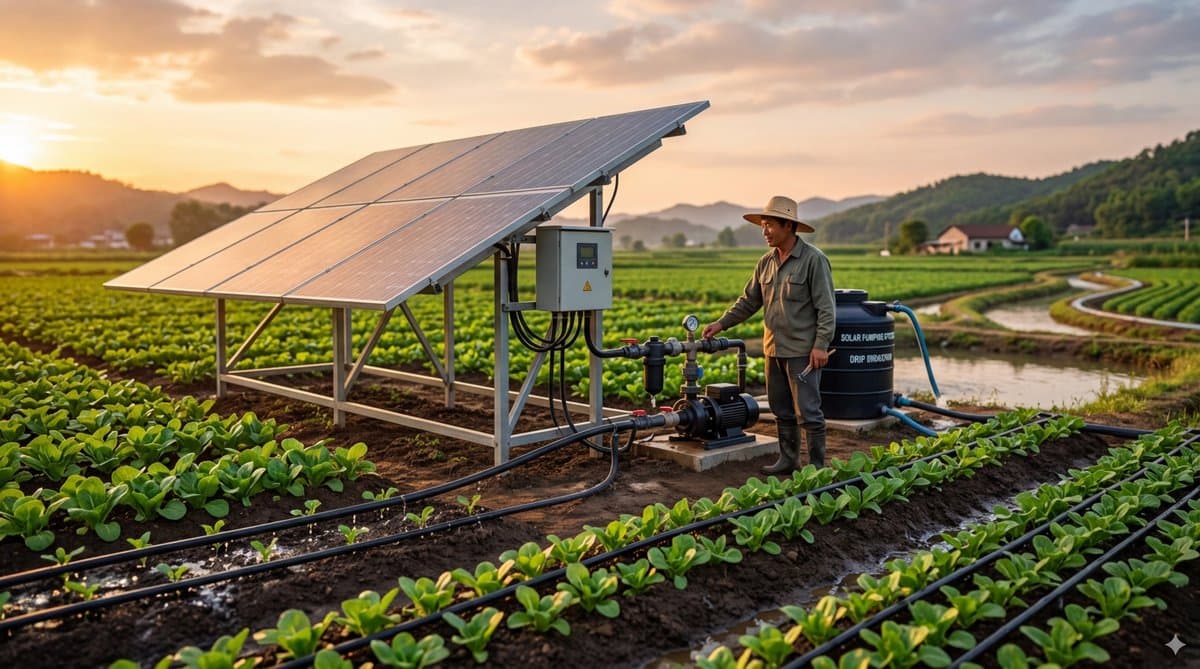
TDH Formula for Solar Pump Sizing & Calculation Tool
Master the TDH formula for solar pump systems with our free online calculator. Size pumps accurately using real engineering formulas and get a quote fast.
Total Dynamic Head (TDH) is the total pressure a solar pump must generate to overcome elevation, friction, and residual pressure requirements. It is calculated as TDH = Hstatic + Hfriction + Hresidual, typically expressed in meters. Accurate TDH calculation ensures optimal pump selection—critical in off-grid solar applications where energy is limited.
Why Total Dynamic Head (TDH) Is Critical for Solar Pump Performance
In off-grid solar water systems used across agriculture, livestock, domestic supply, and water management, every watt-hour from photovoltaic panels counts. Unlike grid-powered systems, solar pumps cannot draw extra power during peak demand—so precise hydraulic modeling is non-negotiable. Underestimating TDH leads to insufficient flow; overestimating wastes costly PV capacity.
TDH directly determines motor power via the formula P = Q·H / (367.2·η), where Q is flow (m³/h), H is TDH (m), and η is pump efficiency. For example, a system requiring 50 m TDH at 6 m³/h with 60% efficiency needs ~1.35 kW—far exceeding the 0.37–0.75 kW range of many standard AC solar pumps like the MNE-3PH series unless properly matched.
Practical Tip: Always measure static head from the dynamic water level (not static water table), accounting for well drawdown during operation—especially critical in mining dewatering or deep borehole applications in arid regions.
Core Engineering Formulas Behind the TDH Calculator
Our free online TDH calculator automates the physics-based equations engineers rely on for reliable off-grid design. Below are the core formulas embedded in the tool:
Total Dynamic Head: $$ \text{TDH} = H_{\text{static}} + H_{\text{friction}} + H_{\text{residual}} $$
Friction Loss (Hazen-Williams): $$ H_{\text{friction}} = \frac{10.67 \cdot L \cdot Q^{1.852}}{C^{1.852} \cdot d^{4.8704}} $$ Where L = pipe length (m), Q = flow (m³/s), C = roughness coefficient (150 for PVC), d = internal diameter (m).
Pump Power: $$ P = \frac{Q \cdot \text{TDH}}{367.2 \cdot \eta} \quad \text{(kW)} $$
Solar Array Sizing: $$ W_{p(\text{array})} = \frac{E_{\text{daily}}}{\text{PSH} \cdot PR} $$ With PR (Performance Ratio) typically 0.75–0.85 to account for temperature derating, soiling, and wiring losses.
These models align with international best practices documented by the Irrigation Association and solar energy standards such as IEC 62253, which Cylome-certified products comply with.
| Parameter | Symbol | Formula / Value | Unit |
|---|---|---|---|
| Static Head | H_static | Dynamic water level to discharge point | m |
| Friction Loss | H_friction | Hazen-Williams or Darcy-Weisbach | m |
| Residual Pressure | H_residual | Required at outlet (e.g., for sprinklers) | m |
| Total Dynamic Head | TDH | H_static + H_friction + H_residual | m |
| Pump Power | P | Q·H / (367.2·η) | kW |
Step-by-Step Walkthrough: Using the Free Online TDH Tool
- Enter Site Data: Input borehole depth, dynamic water level, tank height, and pipe length/material. The tool auto-selects C = 150 for PVC, C = 130 for HDPE.
- Define Flow Requirement: Specify daily water need (e.g., 20 m³/day for livestock). The calculator suggests hourly flow based on local Peak Sun Hours (PSH)—defaulting to winter minima for year-round reliability.
- Review Friction Loss: The tool computes velocity (v) and warns if >2 m/s (agricultural limit) or >1 m/s (domestic), prompting pipe upsizing.
- Get Pump Recommendation: Based on calculated TDH and flow, the system matches compatible models from the MNE-3PH series.
- Export RFQ Package: One-click generates a spec sheet with solar array size, pump model, and wiring diagram—ready for procurement.
Common Mistake: Ignoring residual pressure for drip irrigation (≥10 m) or livestock trough float valves (≥5 m). The tool includes these defaults but allows override.
Request a Quote Browse Products
Real-World Example: Sizing a Solar Pump for a 50m Borehole in Kenya
A farmer in Nakuru needs 25 m³/day for cattle. Local winter PSH = 4.2 hours. Well depth = 60 m, dynamic water level = 45 m below ground. Tank is 5 m above ground. Pipe: 60 m of 1.5" Schedule 40 PVC.
- H_static = 45 m (dynamic level) + 5 m (tank) = 50 m
- Flow = 25 m³ / 4.2 h ≈ 6 m³/h
- Friction loss: At 6 m³/h in 1.5" PVC (ID=44.04 mm), velocity ≈ 1.1 m/s. Using Hazen-Williams: H_friction ≈ 3.2 m
- H_residual = 5 m (for trough valve)
- TDH = 50 + 3.2 + 5 = 58.2 m
The TDH calculator recommends the MNE-3PH-5 (max flow 6.5 m³/h, daily output 20.3 m³) — but notes it falls short on daily volume. Solution: upgrade to MNE-3PH-8 (11 m³/h, 38.3 m³/day) paired with a 1.25 kW solar array. This avoids dry-season shortages while staying within budget due to factory-direct pricing.
Featured AC Solar Water Pump Models

All MNE-3PH series pumps feature corrosion-resistant wetted parts suitable for long-term off-grid operation. Components undergo precision manufacturing processes including CNC machining and quality-controlled assembly. Dimensional tolerances comply with international standards; consult factory for specific values. Minimum order quantity is available on request for all MNE series solar pumps. Factory-direct lead time is typically short due to ready-to-match models and fast production cycles.
How the TDH Calculator Accelerates Your RFQ and Procurement Process
Instead of manual spreadsheets prone to unit errors or outdated friction charts, our online TDH tool integrates real-time product data from Cylome’s catalog. After entering your site parameters, you instantly receive:
- A validated pump model (e.g., MNE-3PH-5 for 50–60 m TDH)
- Recommended solar array size (e.g., 0.75 kW for MNE-3PH-1)
- Compatible pipe sizing guidance
- One-click RFQ generation with technical dossier
This eliminates back-and-forth with suppliers—a major advantage for engineers in construction, solar EPC firms, and water treatment projects where timelines are tight. Since Cylome offers factory-direct supply with fast lead time and 24h quotation, you can move from calculation to deployment in days, not weeks.
Request a quote today with your TDH specs—or use the calculator to auto-generate your RFQ package.
What happens if I underestimate TDH when sizing a solar pump?
The pump will fail to deliver required flow, especially at low irradiance (dawn/dusk or cloudy days). In extreme cases, the motor may stall or overheat due to operating beyond its performance curve. Always include a 10% safety margin for friction loss uncertainty.
Can the TDH formula account for seasonal changes in water table depth?
Yes—but only if you input the worst-case (lowest) dynamic water level. For perennial systems, design for the dry-season drawdown. Our calculator allows manual entry of this value; never use static (non-pumping) water level.
How does pipe material affect friction loss in TDH calculations?
Rougher materials increase friction loss significantly. For example, galvanized steel (C≈120) can have 40% higher loss than PVC (C=150) at the same flow. The calculator defaults to PVC but lets you adjust C for HDPE, polyethylene, or metal pipes.
Is it better to oversize the solar array or the pump motor?
Oversize the solar array, not the motor. A larger PV array (e.g., 1.5× pump rating) ensures operation during suboptimal sun, while an oversized motor wastes energy and increases upfront cost. All MNE-3PH pumps support MPPT controllers that adapt to variable input.
Does the calculator support both DC and AC solar pump models?
Currently, the tool focuses on AC solar water pumps like the MNE-3PH series, which dominate agricultural and livestock applications due to higher power scalability. DC models are planned for future updates.
Last Reviewed: April 2026
Frequently Asked Questions
Cylome Engineering Team
Our team of mechanical and manufacturing engineers brings decades of experience in precision CNC machining, pneumatic systems, and industrial automation. We publish in-depth technical guides to help engineers make informed procurement decisions.


Questions about this topic?
Our engineers are happy to discuss technical details with you.
Ask an Engineer