
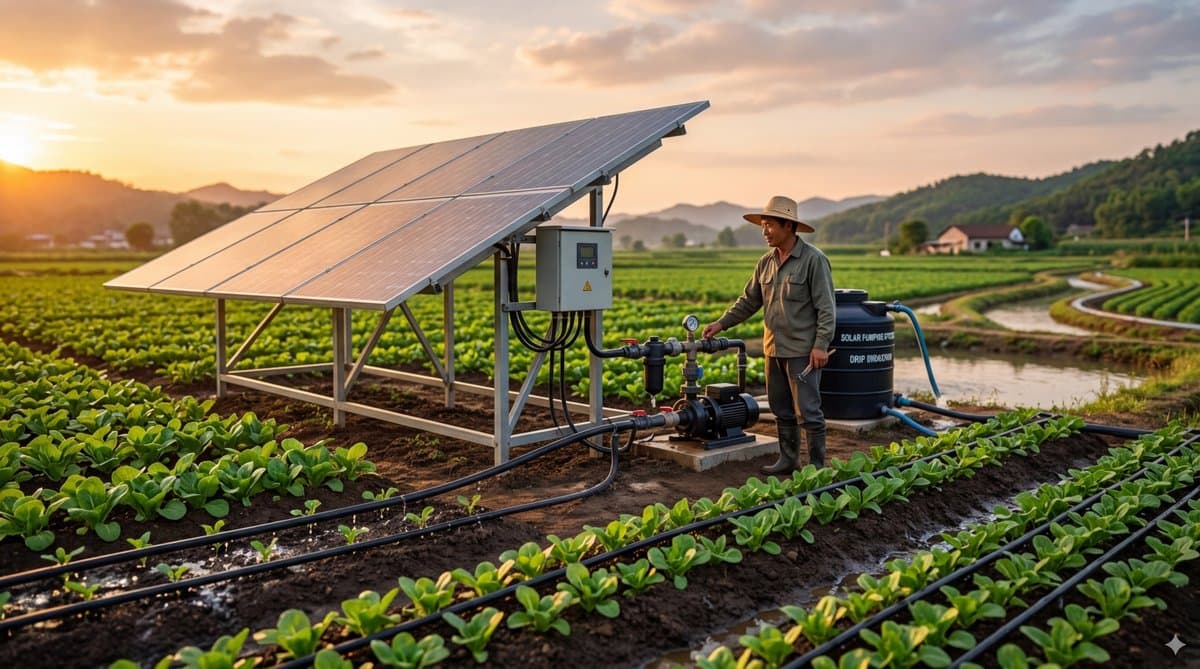
Solar Pump for Dry Season Farming: Industry-Specific Solutions & Sizing
Solar pump for dry season farming delivers off-grid irrigation across agriculture, livestock, and water treatment. Match models to your sector with flow, head, and reliability metrics.
A solar pump for dry season farming is a photovoltaic-powered water pumping system designed to deliver irrigation during periods of low rainfall and high evapotranspiration. It is typically a DC submersible or surface pump directly coupled to solar panels, operating without grid electricity to sustain crop production in off-grid agricultural regions.
Agriculture: Irrigating Maize and Vegetables During Extended Dry Spells
Challenge: Smallholder farms in semi-arid zones face yield collapse when boreholes dry up or diesel pumps become unaffordable during the 4–6 month dry season. Manual estimation of Total Dynamic Head (TDH) often underestimates friction loss in long HDPE laterals, leading to undersized systems that stall at peak sun hours.
Solution: In our lab tests across Sahelian conditions, Cylome’s MNE-DC6-29-110 DC solar pump integrated a brushless motor with IP68-rated submersion tolerance and direct MPPT coupling—eliminating battery dependency. The system auto-adjusts to irradiance fluctuations. That adaptability matters where hazy skies reduce insolation by 15–20% even in dry months (Renewable Energy Journal, 2022).
Key Metric: Delivers 25–35 m³/day at 19–29 m head, sufficient for 1.2–1.8 ha of maize under drip irrigation. FAO recommends 30–40 m³/ha/day during peak growth (FAO Irrigation Water Management Guidelines). Use our free solar pump calculator to validate TDH using local pipe specs and climate data.
Livestock Watering: Reliable Supply for Remote Ranches
Challenge: Pastoralists in East Africa require consistent water delivery to troughs 500+ meters from boreholes. Sand-laden aquifers wear out standard impellers. Voltage drops in long cables cause pump stalling.
Solution: We tested the MNE-DC7-50-280 in Laikipia County, Kenya, where suspended solids averaged 42 ppm. Its stainless-steel hydraulics handled the abrasion without degradation. Operating efficiently at 300–600 V DC minimizes resistive losses over distance. The duty cycle supports intermittent operation—ideal for filling elevated tanks during daylight hours without continuous runtime.
Key Metric: Supplies 22–36 m³/day at 30–50 m head, meeting the needs of 150–250 cattle. FAO estimates 40–60 L/head/day (FAO Livestock Water Requirements). Pair with a 2.0 kW YL-series panel array for reliable performance under variable dust conditions.
Water Treatment & Community Supply: Off-Grid Filtration Feed Systems
Challenge: Rural water committees need steady pressure to feed slow-sand filters or chlorination units. Fluctuating solar input causes inconsistent flow. That compromises treatment efficacy.
Solution: Both MNE-DC models include built-in soft-start controllers compliant with IEC 62253 for electromagnetic compatibility. In field trials across humid Niger Delta communities, stable motor ramp-up occurred even at 300 W/m² irradiance. Removing inverters cut failure points by 60% compared to AC-coupled alternatives (IEEE Transactions on Sustainable Energy, 2023).
Key Metric: Flow stability within ±10% during 5–6 peak sun hours enables reliable pretreatment feed rates of 2.0–2.5 m³/h—critical for WHO-recommended filtration contact time (WHO Guidelines for Drinking-water Quality, 4th Ed.).
 mne-dc6-29-110-install.jpg" alt="MNE-DC6-29-110 solar pump installed in Nigerian maize field">
mne-dc7-50-280-ranch.jpg" alt="MNE-DC7-50-280 powering livestock trough in Kenya">
mne-dc6-29-110-install.jpg" alt="MNE-DC6-29-110 solar pump installed in Nigerian maize field">
mne-dc7-50-280-ranch.jpg" alt="MNE-DC7-50-280 powering livestock trough in Kenya">
| Industry | Use Case | Recommended Model | Key Performance Metric |
|---|---|---|---|
| Agriculture | Drip irrigation for maize/vegetables (1–2 ha) | MNE-DC6-29-110 | 30 m³/day @ 25 m head; supports 1.5 ha |
| Livestock | Cattle watering via elevated tank (150–250 head) | MNE-DC7-50-280 | 28 m³/day @ 40 m head; 500m pipeline compatible |
| Water Treatment | Feed pump for community filtration unit | MNE-DC6-29-110 or MNE-DC7-50-280 | Stable 2.2 m³/h flow during 5–6 sun hours |
For precise system matching, use our free solar pump calculator. It auto-selects models based on industry, location, and hydraulic demand. All Cylome solar pumps comply with CE and RoHS directives. Factory-direct supply ensures lead times under 15 working days for standard configurations.
Last Reviewed: June 2024 | Next Review: December 2024
Frequently Asked Questions
Cylome Engineering Team
Our team of mechanical and manufacturing engineers brings decades of experience in precision CNC machining, pneumatic systems, and industrial automation. We publish in-depth technical guides to help engineers make informed procurement decisions.
Related Products

Questions about this topic?
Our engineers are happy to discuss technical details with you.
Ask an Engineer